Arizona chip-boom at early stage
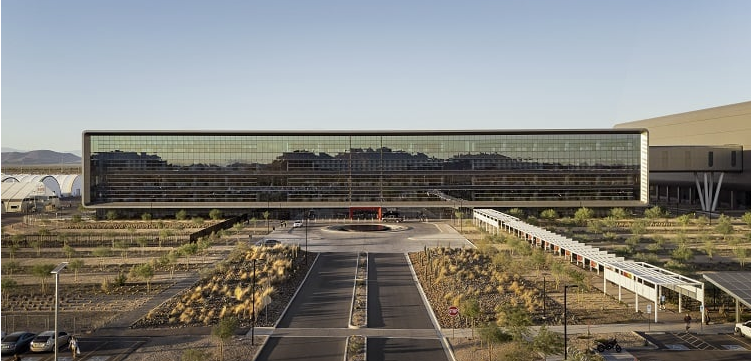
One of the completed fabs just outside of Phoenix, Arizona that will be TSMC’s hub for semiconductor manufacturing to support the growth of chipmaking in the U.S.
Over the past several years, Arizona has rapidly emerged as a major semiconductor manufacturing hub, driven largely by the expansion of Taiwan Semiconductor Manufacturing Co. (TSMC). The world’s largest chipmaker selected the state for a series of leading-edge fabrication plants, triggering a wave of additional investment as suppliers and partners moved to build around the growing ecosystem.
Expansion plans accelerate
In January 2026, TSMC reinforced its long-term commitment with a $197 million land acquisition in Arizona. The purchase is widely seen as preparation for further fabrication facilities, reflecting the company’s confidence in sustained semiconductor demand across the U.S. market.
The newly acquired land near Phoenix could accommodate at least five additional fabs. TSMC is already constructing three fabs in Arizona, with another three planned. Arizona Fab 1 has been operational since Q4 2024, while Fab 2 is complete and scheduled to begin production by 2028. Fabs 3 through 6 are targeted for production by 2030. In parallel, the company is building two advanced packaging facilities expected to come online by 2028.
Universities strengthen the talent pipeline
Arizona’s universities are aligning closely with industry growth. The University of Arizona has formalized a partnership with Taiwan’s National Yang Ming Chiao Tung University (NYCU), a key talent supplier to companies in Taiwan’s Hsinchu Science Park.
University of Arizona President Suresh Garimella described the agreement as a pivotal step in strengthening ties with Taiwan and supporting the global semiconductor ecosystem. The partnership will establish a Talent and Innovation Hub focused on areas such as materials science, advanced packaging and photonics — disciplines critical to next-generation chip manufacturing.
Meanwhile, Arizona State University (ASU) has also expanded its semiconductor footprint. In 2025, the U.S. Department of Commerce selected ASU to host two major initiatives: the NNSTC Prototyping facility and the NAPMP Advanced Packaging Piloting Facility. Both are expected to open by 2028.
A broader ecosystem takes shape
The state’s momentum extends beyond fabrication. Amkor Technology has begun construction of an advanced packaging and testing facility in Arizona as part of its $7 billion U.S. investment plan. The campus is designed to complement TSMC’s Phoenix fabs, enabling a more complete, end-to-end chip manufacturing supply chain. In October 2024, Amkor and TSMC signed an agreement to support customer designs, particularly those tied to TSMC’s Arizona operations.
Arizona’s semiconductor landscape was already anchored by Intel Corporation, which operates a major fab cluster at its Ocotillo campus in Chandler. The company has committed $20 billion to expand the site with two additional fabs.
According to the Arizona Commerce Authority, more than 35 semiconductor companies are planning expansions or relocations to the state. Dozens of supply chain firms — spanning chemicals, packaging and transportation — are also moving into the region.
At SEMICON West, held in Phoenix for the first time in 2025, Governor Katie Hobbs highlighted more than 60 semiconductor expansions totaling approximately $205 billion in investment. The event brought together over 600 ecosystem partners from 17 countries, underscoring Arizona’s growing international profile.
Recent investments include expansions by ASM in North Scottsdale; Xnrgy in Mesa; Applied Materials’ materials-to-fab center; chemical ventures by KPCT Advanced Chemicals and Chang Chung in Casa Grande; Sunlit Chemical’s $100 million land acquisition in Phoenix; Fujifilm’s $88 million Mesa expansion; Air Liquide’s $60 million Phoenix facility; and Pentagon Technologies’ wafer-cleaning operations in Mesa.
Together, these developments signal that Arizona is no longer simply attracting fabs — it is building a comprehensive semiconductor ecosystem spanning manufacturing, packaging, research and supply chain infrastructure.

Project News