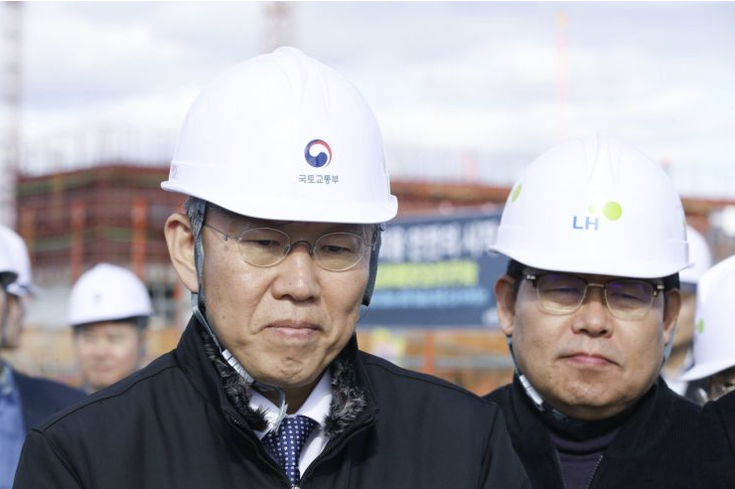
Kim Itak (left), First Vice Minister of Land, Infrastructure and Transport.
South Korea is stepping up efforts to address a growing shortage of skilled construction workers as demand surges from both semiconductor manufacturing projects and large-scale housing developments.
The Ministry of Land, Infrastructure and Transport announced on Nov. 24 that it has established a Public-Private Council on Construction Professionals, bringing together government agencies, major developers, contractors, and industry groups to coordinate workforce planning. The initiative comes amid projections that more than 260,000 additional workers will be needed by 2030 to support semiconductor facility construction, while more than 1.5 million homes are also scheduled to begin construction across the Seoul metropolitan area.
The ministry held a meeting in Seoul, led by First Vice Minister Kim Itak, with representatives from project owners Samsung Electronics, SK hynix, and Korea Land and Housing Corporation (LH), alongside contractors Samsung C&T and SK ecoplant, major subcontractors, and several construction industry associations.
Under the new council, government and industry leaders will regularly assess labor demands at construction sites and develop workforce solutions. As an initial measure, both sectors will collaborate on education and training programs designed to quickly prepare specialized workers for deployment at semiconductor manufacturing projects.
In addition to semiconductor construction, the ministry plans to expand workforce development efforts for residential construction. Proposed measures include tailored training programs linked to the Construction Worker Skill Grade System, as well as initiatives to attract unemployed workers and retired military personnel into the industry.
Construction companies warned that labor shortages are already becoming a significant challenge. Industry representatives said workforce demand tied to semiconductor projects alone is expected to exceed 260,000 workers by 2030, creating intense competition for skilled labor.
Particularly acute shortages exist in specialized trades such as piping, welding, and ductwork, which are critical to semiconductor fabrication facilities. Unlike general construction roles, these positions require advanced technical expertise and extensive training. Industry officials noted that workers involved in precision piping typically need one to two years of training and hands-on experience before they can operate independently on semiconductor projects.
Current workforce figures highlight the gap. As of late October, South Korea had nearly 102,000 workers in building piping, but only about 1,150 specialists in industrial plant piping. Similarly, while more than 15,000 general welders were available, there were only 620 plant welders and just five specialty plant welders nationwide. Plant-specific ductwork specialists are also in short supply.
Industry leaders expressed concern that the rapid expansion of semiconductor construction could draw workers away from residential building projects, creating additional pressures as housing construction accelerates.
The demographic makeup of the construction workforce is also raising concerns. Workers in their 50s account for roughly one-third of the industry, while those aged 60 and older represent nearly another third. In contrast, workers in their 20s and 30s make up only 18% of the workforce, underscoring the industry's difficulty attracting younger talent.
Contractors and subcontractors also said it is difficult for individual companies to independently develop and retain skilled workers. Even when training programs are offered, many workers move to competing firms after completing their education. Industry representatives therefore called for greater government involvement in workforce training, the creation of a centralized recruitment information system, and improvements to worker accommodations and living conditions at construction sites.
Vice Minister Kim said the government will continue working with relevant agencies and industry partners through the new council to identify practical solutions. He added that the goal is not only to address labor shortages but also to create employment opportunities for regional construction firms and support local economic growth across the country.

Project News