Seagate set to become world’s largest semiconductor laser producer by 2028
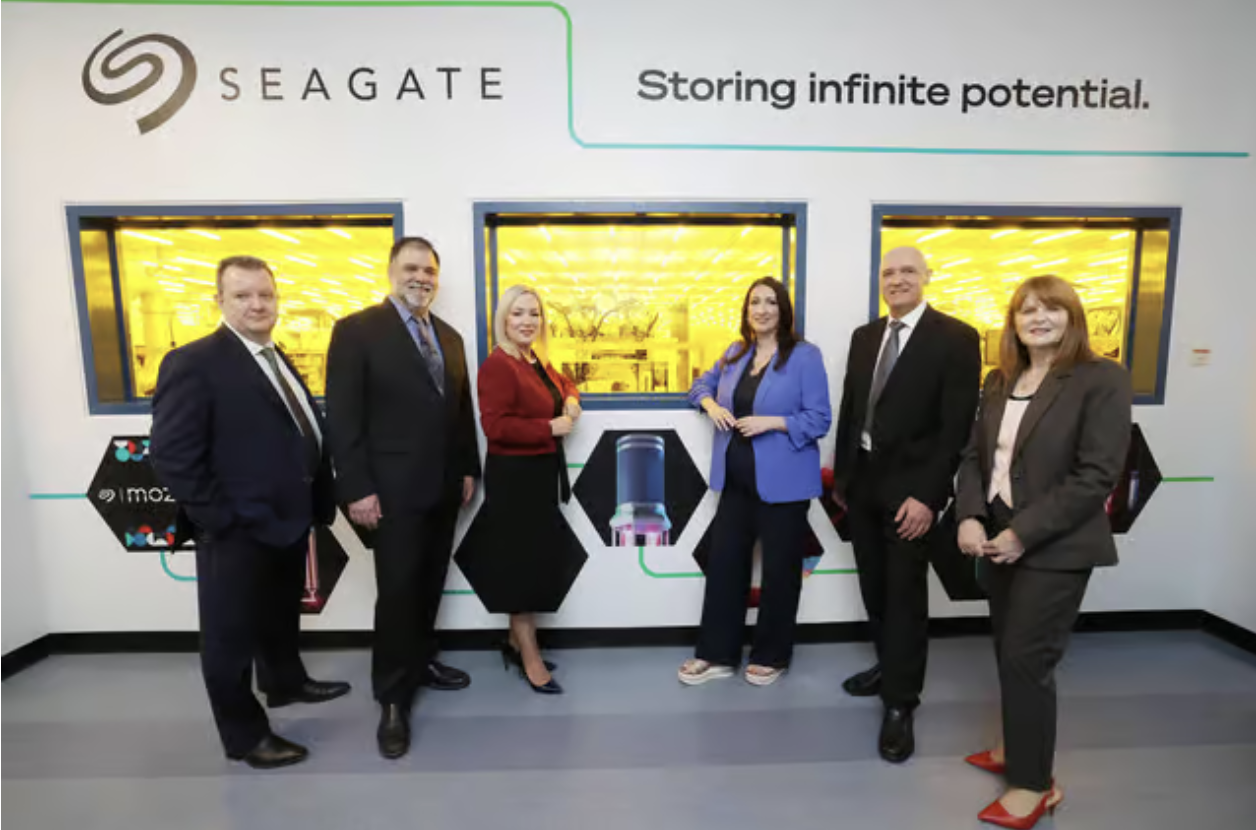
The investment announced last September has already yielded at least 30 highly-skilled jobs at Springtown.
Seagate is on track to become the world’s largest producer of semiconductor lasers by early 2028, according to evidence presented to MPs.
The data storage giant’s Derry/Londonderry facility is expected to overtake south-east Asia as the leading global manufacturer and exporter of semiconductor lasers, driven by advances in nano-photonics and next-generation hard drive technology.
Sam Turner, Chief Executive Officer of the Advanced Manufacturing Innovation Centre at Queen’s University Belfast, told the Northern Ireland Affairs Committee that Seagate’s Springtown site is a global leader in light-based laser technology used in data storage.
“In semiconductors and lasers, we have Seagate in the north-west producing the read/write heads for its hard drives. It is currently the biggest producer of lasers in Europe and will, within around 18 months, become the largest producer of lasers by volume in the world,” Mr Turner said.
The committee is examining economic growth opportunities in emerging industries across Northern Ireland. Mr Turner explained that Seagate has developed a new form of technology — heat-assisted magnetic recording (HAMR) — which uses advanced nanotechnology lasers to improve data storage capacity.
“Seagate is a hard drive company, but it has created a new technology using nanotech lasers that it has developed. These will be produced at high volume and at affordable prices, and the company is exploring opportunities to bring this technology into new markets,” he told MPs.
On the same day, Alison Currie, Chief Development Officer at Invest NI, highlighted Seagate’s £115 million research and development investment announced last year in nano-photonics and next-generation hard drive development in Derry. The project has already created at least 30 highly skilled jobs at Springtown.
Speaking to the Stormont Economy Committee, Ms Currie described the investment as one of the largest R&D projects ever secured by Invest NI for Northern Ireland.
“The Seagate R&D project in the north-west was the result of a highly competitive process to ensure that the investment came to Northern Ireland,” she said.
“It has positioned the north-west and Northern Ireland as a centre of excellence in photonics. There is outstanding work taking place there, along with strong supply chain opportunities, creating significant potential for the region.”
Seagate has also benefited from growing demand for data storage driven by artificial intelligence (AI). In written evidence submitted to the Northern Ireland Affairs Committee inquiry into new and emerging sectors, the company said it remains a critical part of the global digital infrastructure.
“Seagate is the world’s leading manufacturer of digital storage solutions. One third of all global data is stored on a Seagate-made drive in data centres around the world,” the company stated.
The firm added that its Springtown facility plays a central role in its global operations, producing a significant proportion of the recording heads used in hard disk drives.
“Every year, our Northern Ireland plant produces between one fifth and one fourth of all hard disk drive recording heads, the components that allow data to be written and read from storage media.”
Seagate reported strong financial results for the quarter ending in March, including record margins and almost $1 billion in free cash flow.
The company’s Chief Executive Officer, Dave Mosley, said Seagate is entering a period of significant growth as AI continues to increase demand for data storage.
“We believe Seagate is entering a new era of structural growth as AI applications amplify data creation and support sustained storage demand,” Mr Mosley said.
“Our high-capacity, energy-efficient storage products position us to capture these opportunities, drive profitable growth, and create long-term value.”

Project News