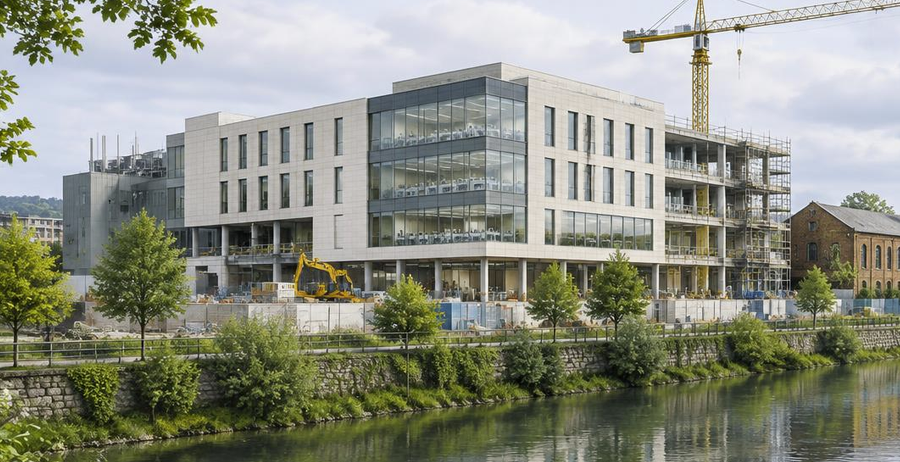
Tyndall National Institute Expansion Advances Into Construction Phase
The expansion of Tyndall National Institute in Cork has moved beyond planning and procurement into active delivery. According to University College Cork (UCC), which updated its project information on 23 October 2026, the facility is now under construction and remains on course for completion in Q4 2028. While the project has clearly progressed to the delivery stage, publicly available sources do not provide a detailed construction programme or an official completion percentage.
A Strategic Expansion for Irish Research
Founded in 2004 through a partnership between the Irish Government and UCC, Tyndall has grown into one of Europe’s leading research centres for semiconductors, photonics and information and communications technologies. In a July 2026 announcement, the institute identified increasing demand for its facilities and expertise as a limiting factor on future growth.
The new development is intended to address those pressures by significantly increasing research capacity. Once complete, the facility is expected to accommodate a doubling of the institute’s capacity while more than doubling its physical footprint. The project is positioned as an investment in research infrastructure, talent development and industry collaboration rather than a disclosed increase in commercial semiconductor manufacturing capacity.
From Approval to Construction
Reports from Building and Architect of the Year, citing the Irish Examiner, indicate that planning permission for the scheme was secured in 2023 and that a commencement notice was subsequently lodged with Cork City Council. Together, these milestones marked the transition from an approved project to one entering the construction phase.
UCC’s latest project update provides the clearest confirmation that construction activity is now underway. However, neither UCC nor Tyndall has publicly identified the precise date on which building works began, so no specific construction start date can be verified.
Funding and Procurement Milestones
UCC records a government capital-funding commitment of €100 million announced in February 2026. Further momentum followed on 3 July 2026, when Taoiseach Micheál Martin and Minister James Lawless formally announced the expansion project.
At that time, Tyndall stated that the required Exchequer funding had been approved and that UCC had been authorised to enter into a contract with its preferred contractor. The announcement described an investment exceeding €100 million and noted support through the INSPIRE programme.
It is important to distinguish the published €100 million government commitment from any final project budget or construction contract value. Those figures have not been disclosed in the primary sources currently available.
Design and Location
The new facility will occupy a site on UCC’s North Mall Campus, across the River Lee from Tyndall’s existing headquarters on Dyke’s Parade. UCC describes a building of approximately 17,500 square metres, rising from four storeys at its eastern end to seven storeys at its western extremity.
Part of the development incorporates the lower single-storey section of the former Bottling Plant, reflecting the project’s effort to integrate existing industrial heritage with a modern research environment.
The building programme includes:
Advanced laboratories and specialist research facilities
Collaborative innovation spaces
Seminar and meeting rooms
Office accommodation
Exhibition areas
A café
Facilities for industry partners, start-ups and enterprise clients
A consolidated parking area providing 154 spaces
Differences Between Published Descriptions
Not all published accounts describe the project in identical terms. A construction-industry report references a floor area of 16,135 square metres and a building height ranging from four to six storeys. By contrast, UCC’s latest project description specifies approximately 17,500 square metres and a height of four to seven storeys.
For consistency, the current client-issued figures from UCC provide the basis for the project description presented here. The available sources do not explain whether the differences result from changes in project scope, updated measurements or alternative reporting conventions.
Importantly, the reported floor area represents the building’s total size and should not be interpreted as a measure of cleanroom space or specialised research capacity.
Heritage and Campus Connectivity
The redevelopment of the former industrial site forms a significant part of the project narrative. Industry reports describe a move away from more extensive demolition plans toward the retention of several heritage elements, including sections of the southern façade, the existing chimney and loading-bay canopies. UCC separately confirms the incorporation of the lower Bottling Plant structure into the final design.
These measures illustrate the challenge of integrating a state-of-the-art research facility within a site that retains important industrial features.
Construction reporting has also referenced a proposed pedestrian and cycle bridge linking the development to the existing Tyndall campus. However, procurement arrangements and delivery timelines for that bridge have not been confirmed in the primary sources and should be considered separately from the main building programme.
Delivery Team
UCC identifies the following organisations as members of the project team:
Scott Tallon Walker – Architect
Curtins Consulting – Civil and Structural Engineering
BB7 – Fire Engineering and PSDP Services
O’Connor Sutton Cronin & Associates – Mechanical and Electrical Engineering
Aecom – Quantity Surveying
The client-side project team includes Tim Cronin, Interim Director of Buildings & Estates, and Finbarr Wall, Deputy Capital Projects Officer.
While these appointments are publicly documented, UCC has not disclosed the identity of the project’s main construction contractor or any mechanical and electrical installation contractor. Design consultants should therefore not be assumed to be delivery contractors.
Key Project Timeline
2023
Planning permission reported by construction-industry sources
February 2026
UCC records a €100 million government capital-funding commitment
3 July 2026
Expansion officially announced
Funding approval confirmed
UCC authorised to contract with its preferred contractor
23 October 2026
UCC confirms the project is under construction
Q4 2028
Current target completion window
The 2028 milestone remains a projected delivery target rather than a completed achievement or guarantee of immediate operational readiness.
What Happens Next?
The public record confirms that the project has entered construction but does not yet provide evidence of several major delivery milestones, including:
Structural completion
Building enclosure and weather-tightness
Installation of laboratory systems
Research equipment fit-out
Testing, commissioning and handover
These stages will provide clearer indicators of progress as work advances and will be particularly significant for a facility intended to support highly specialised research activities.
Additional public information on the main contractor, contract value, campus bridge arrangements and final commissioning plans would further improve visibility into the project’s delivery pathway.
Assessment
The clearest evidence of progress is the shift from a funded, contract-ready project in July 2026 to confirmed construction activity by October 2026. Beyond its physical scale, the expansion carries strategic significance. Tyndall links the project to its 2030 vision, Ireland’s Silicon Island semiconductor strategy and wider European research ambitions, while UCC highlights its importance for future advances in quantum technologies and photonics.
If delivered as planned, the new facility should help alleviate existing capacity constraints, attract talent and strengthen collaboration between researchers and industry. Based on the evidence currently available, the project is a strategically important research investment with a clearly stated delivery target, although several key construction and commissioning milestones remain to be publicly documented.

Project News