The Constraint You’re Not Measuring: Where Semiconductor Capacity is Actually Lost
Crediting this article to the authors: Doug Rice, PE, PhD and Chris Vigil, PMP. Along with Black & Veatch.
The semiconductor industry has no shortage of capacity metrics: fab size, tool utilization, throughput, yield, and capital investment. These measurements help leaders understand how much capacity they're building and how quickly they're bringing it online, but they fail to tell the whole story.
As the industry races to expand, a growing share of capacity is being shaped by semiconductor infrastructure systems that rarely appear on performance dashboards: power availability, water security, permitting timelines and utility resilience. These factors increasingly determine whether a facility achieves its intended performance.
The challenge? Capacity is lost before a fab reaches its full potential, not from a lack of data, but from a lack of whole-system evaluation.
The capacity challenge hiding in plain sight
When semiconductor leaders talk about capacity, the conversation typically centers on production: How quickly can we scale? How much output can we generate? How fast can new facilities come online?
The urgency is understandable. Demand remains high and speed to market matters. Capacity discussions are often driven by throughput, expansion, and operational efficiency because those are the most immediate business priorities.
Yet the environment surrounding those decisions has changed.
Five years ago, the primary challenge was building more capacity. Today, organizations are competing for power infrastructure, electrical equipment, water resources, and critical utility connections. Lead times are longer. Public scrutiny is higher. Infrastructure planning has become more complex.
That shift has important implications.
The industry's next capacity challenge may not be production capability. It may be infrastructure readiness.
An example of hidden semiconductor capacity constraints
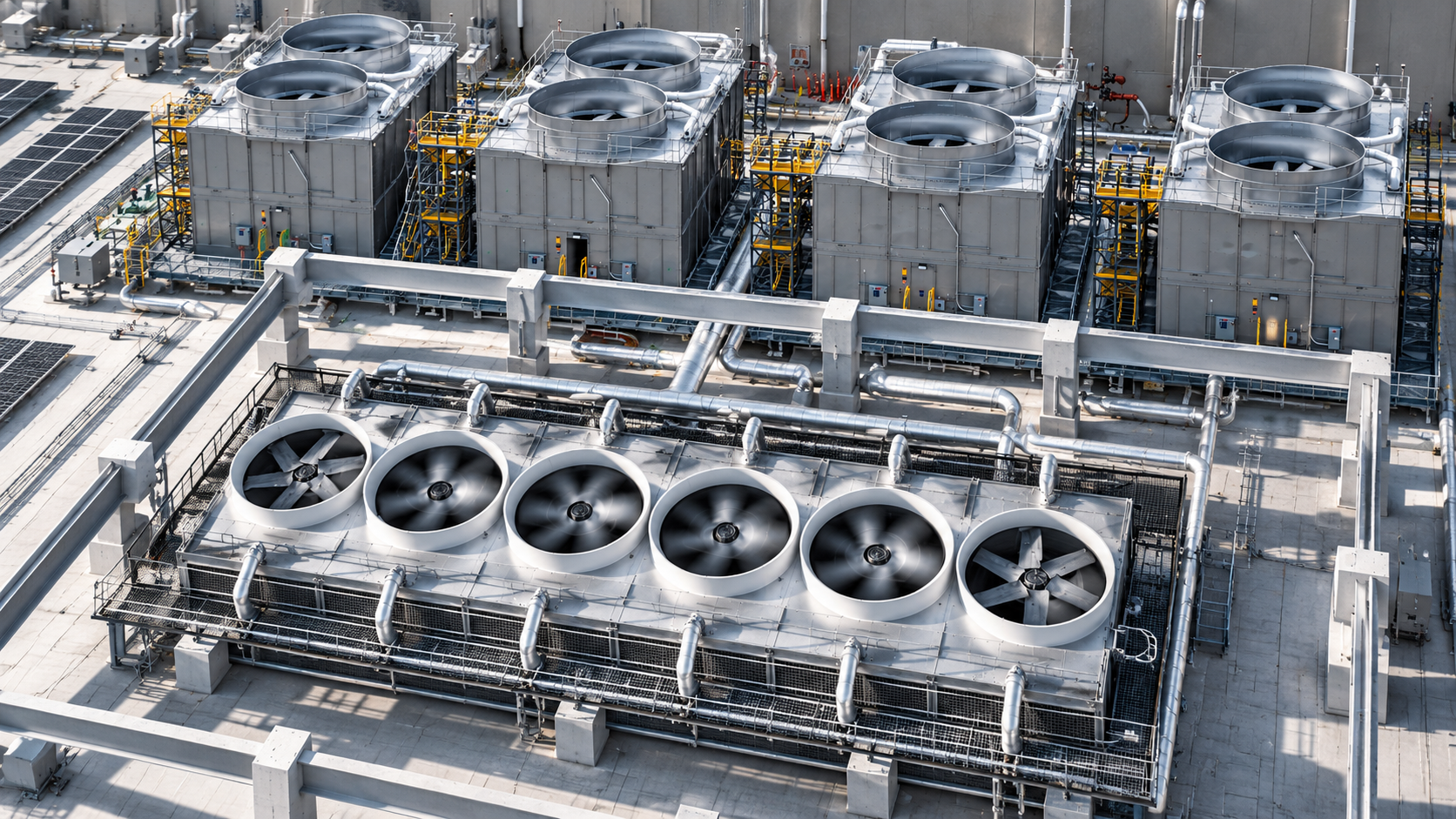
Take a cooling tower. Its job is simple: remove heat and keep the semiconductor facility running reliably. It performs exactly as designed, making it a powerful example.
Cooling towers release water vapor into the atmosphere as part of normal operation. Historically, that plume has been viewed simply as a byproduct of heat rejection.
Doug Rice, PE, PhD, a Black & Veatch process engineer based in Phoenix, Arizona, sees it differently.
"The industry should begin viewing the plume as a valuable and renewable source of highly purified water rather than something to discard.”
The water contained in that plume has effectively gone through a distillation process during evaporation. In an industry that places enormous value on water quality, cooling tower exhaust represents a potentially valuable resource stream that is largely overlooked today.
The scale is significant.
Cooling towers can vent millions of gallons of water per day, and recovery opportunities can also be measured in millions of gallons, depending on facility conditions and available technology.
Atmospheric water harvesting offers one way to capture and reuse a portion of that resource.
But the larger point extends beyond the technology itself.
If a system this common is releasing a valuable resource while functioning exactly as intended, what other opportunities are being missed across the infrastructure ecosystem?
Semiconductor infrastructure as a connected system
The cooling tower story points to a bigger issue. Semiconductor infrastructure is typically measured against its primary purpose: power delivers electricity; water provides treatment and reuse, and cooling systems remove heat. But a system can perform exactly as designed while leaving valuable resources or capacity behind.
What receives less attention are the interactions between systems.
As Chris Vigil, PMP, an integrated solutions strategist for the Infrastructure Advisory group at Black & Veatch, notes:
"Viewing infrastructure holistically adds an entirely new layer of strategy."
Opportunities emerge when organizations look beyond individual assets and evaluate infrastructure as an interconnected ecosystem.
Power systems may be sized for peak demand yet operate well below those levels most days. Water systems may excel at recycling while still leaving recovery opportunities unexplored. Facility designs may separate process decisions from utility decisions, limiting visibility into broader optimization opportunities. Even project delivery approaches can absorb redesign and rework as routine costs rather than symptoms of earlier planning gaps.
As semiconductor campuses become larger and more complex, these interactions become increasingly important.
Scale changes what matters.
What once appeared insignificant can become a meaningful constraint.
The shift from solving constraints to designing for them
Infrastructure decisions are typically made in response to an identified constraint: insufficient power, a required utility upgrade, limited water supply, etc.
By the time those constraints become visible, the range of available options has often narrowed; costs rise, schedule flexibility decreases, risk becomes more difficult to manage.
As semiconductor facilities become larger and more complex, organizations have an opportunity to take a different approach. Instead of asking, "How do we solve this constraint?" leading organizations are beginning to ask, "What constraints are we not seeing yet?"
That shift changes how infrastructure is planned.
Power availability, water sourcing, permitting requirements, utility resilience and supply chain considerations become interconnected variables rather than isolated challenges. Evaluating those variables early creates opportunities to identify vulnerabilities, understand tradeoffs, and improve certainty before critical project decisions are made.
Organizations that take a system-wide view can often recognize risks long before they appear on a project schedule or operational dashboard.
The objective isn't simply to respond to constraints. It's to understand where they may emerge and design around them before they limit performance.
What forward-looking semiconductor leaders do differently
The organizations that consistently outperform aren't necessarily measuring more data. They're measuring different things. Three practices stand out:
1. Measure losses alongside outputs
Traditional capacity metrics remain important. But leading organizations also examine infrastructure performance, resource availability, and system dependencies that can influence production outcomes.
They ask a different set of questions:
· Where are critical resources leaving the system?
· What constraints are emerging outside production metrics?
· Which inefficiencies become more significant as the facility scales?
Understanding losses can be just as important as measuring output.
2. Integrate infrastructure earlier
Power, water, and facility planning deliver the greatest value when evaluated together rather than in isolation.
Early integration can help organizations:
· Identify hidden dependencies
· Understand infrastructure tradeoffs
· Improve planning certainty
· Reduce downstream redesign
The earlier infrastructure considerations enter decision-making; the more options organizations typically have available.
3. Design for recovery and resilience
Every constrained resource deserves strategic attention.
The most resilient organizations look beyond immediate operational requirements and consider how systems can recover value, maintain flexibility, and adapt to future demands.
That mindset creates opportunities to strengthen reliability while uncovering efficiencies that might otherwise remain hidden.
The common thread is perspective.
Semiconductor infrastructure becomes a strategic asset rather than a collection of supporting utilities.
The bigger idea
The semiconductor industry does not lack ambition or demand. Rather, it often lacks visibility in where capacity is quietly being lost.
The cooling tower example illustrates the point. A system can perform exactly as intended while still releasing a valuable resource. The same principle applies across power, water, facilities, and project delivery systems.
As semiconductor campuses grow larger and more complex, those interactions become increasingly important.
When organizations take a broader view, they begin to uncover opportunities that may never appear in conventional capacity metrics. They can identify hidden constraints earlier, strengthen resilience, and improve the likelihood that critical infrastructure performs as intended over the life of a facility.
The organizations that gain an advantage won't necessarily be those that build the most capacity; they'll be the ones that preserve more of the capacity they already have.
The constraint is hidden because the infrastructure has not been evaluated as a system, not simply because the data is non-existent.
For semiconductor leaders, that's becoming an increasingly important distinction.
For Black & Veatch, it's also why semiconductor infrastructure advisory, planning and delivery must be considered together. The most effective strategies often emerge when organizations evaluate power, water, facilities, and project execution as interconnected parts of the same challenge rather than separate decisions.
As the semiconductor industry continues to evolve, organizations that understand those interdependencies will be better positioned to improve resilience, reduce uncertainty, and unlock performance across the entire infrastructure ecosystem.
Frequently asked questions
What is semiconductor infrastructure?
Answer: Semiconductor infrastructure includes the power, water, cooling, utility and facility systems that enable fabs to operate reliably at scale. These systems influence operational performance, resilience, and long-term growth.
What drives semiconductor capacity growth?
Answer: Capacity growth is traditionally linked to throughput, facility expansion, and equipment performance. Increasingly, semiconductor infrastructure planning, utility availability and supply chain conditions influence how quickly that capacity can be brought online and sustained.
How do utilities affect semiconductor capacity and uptime?
Answer: Reliable power and high-quality water are essential to semiconductor manufacturing. Utility disruptions can cause production interruptions and lengthy restart processes that reduce effective capacity.
Which semiconductor infrastructure bottlenecks limit fab expansion most?
Answer: Common constraints include power availability, water availability, utility resilience, permitting requirements and long lead times for critical infrastructure equipment and grid assets.
How can companies mitigate semiconductor capacity constraints?
Answer: Organizations can reduce risk by identifying constraints early, integrating infrastructure planning across disciplines, modeling vulnerabilities during development, and incorporating resilience into project design.
How do capacity constraints affect chip supply and lead times?
Answer: When infrastructure or utility limitations slow expansion plans or interrupt production, they can reduce available manufacturing capacity and extend the time required to bring products to market.
How can infrastructure resilience reduce semiconductor disruptions?
Answer: Infrastructure resilience strengthens reliability across power, water, and facility systems. Organizations that plan for disruptions, redundancy, and recovery are better positioned to sustain production and minimize operational impacts.
About the authors
Doug Rice, PE, PhD
Doug Rice is a process engineer with Black & Veatch based in Phoenix, Arizona. His work focuses on water, wastewater, and resource recovery solutions, including applications for semiconductor manufacturing facilities.
Chris Vigil, PMP
Chris Vigil is an integrated solutions strategist with the Infrastructure Advisory group at Black & Veatch. He helps clients evaluate infrastructure holistically, identifying risks, constraints, and opportunities across the project lifecycle.
What capacity constraints aren't you measuring?
Bring together infrastructure advisory, planning and delivery to identify interdependencies earlier, reduce uncertainty, and improve outcomes across the project lifecycle. Connect with a Black & Veatch expert.

Project News