Ireland & Vietnam SemiCon Collaboration
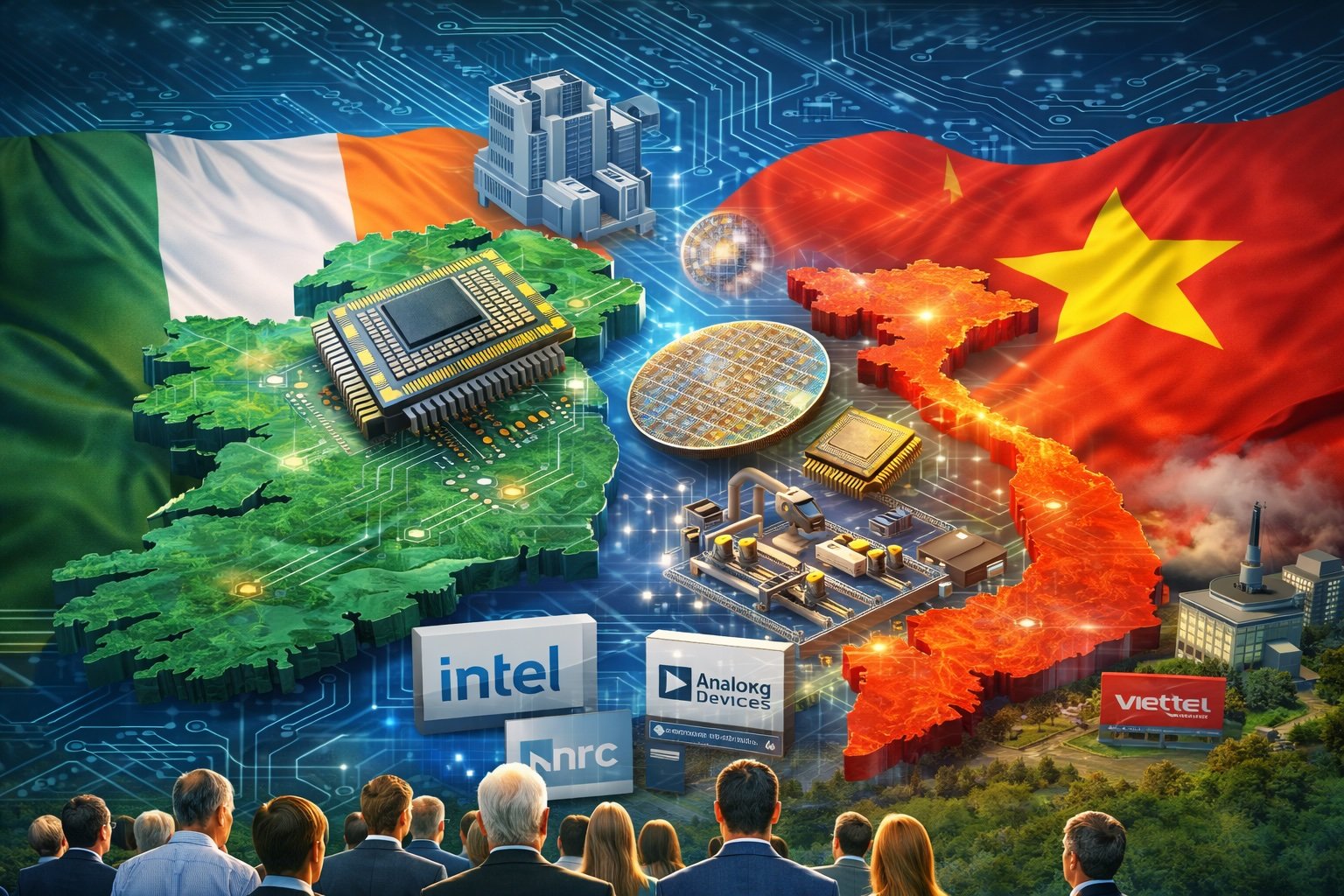
Through “Silicon Island” strategy, Ireland is positioning itself as a global hub for semiconductor research and innovation.
Ireland and Vietnam sit at opposite ends of the world, with limited histories in semiconductor manufacturing and relatively small shares of the global market. Yet over the past decade, both countries have carved out increasingly important roles within the global chip supply chain.
Their rise has helped make semiconductor supply to Europe and the United States more cost-effective, resilient, and less reliant on China. It also highlights a broader reality: no single country—not even the US—can independently deliver a fully competitive, end-to-end semiconductor ecosystem.
Instead, success depends on collaboration among trusted partners. The Netherlands supplies cutting-edge lithography machines, while Taiwan and South Korea dominate advanced chip manufacturing. Alongside these major players, smaller nations such as Ireland and Vietnam are proving their value in more specialised areas.
Ireland has emerged as a leader in semiconductor design, research, and high-value manufacturing. Vietnam, by contrast, has built strength in packaging—the final stage of chip production, where delicate silicon dies are protected, cooled, and connected to electronic systems. Over time, Vietnam has developed a robust electronics assembly and testing sector, benefiting from global efforts to diversify supply chains away from China. Now, it is moving further up the value chain.
Major investments reflect this shift. US-based Amkor is committing around $1.6 billion to a high-end packaging facility in Bac Ninh. Meanwhile, state-owned Viettel broke ground in early 2026 on a semiconductor fab at Hoa Lac Hi-Tech Park near Hanoi, targeting production of 32-nanometre chips. While this lags behind the most advanced nodes produced elsewhere, Vietnamese policymakers see it as a stepping stone toward greater capability. National plans aim to train 50,000 design engineers by 2030 and grow the semiconductor workforce to over 100,000 by 2040.
Ireland’s ambitions differ. Through its “Silicon Island” strategy, the country is positioning itself as a global hub for semiconductor research and innovation, supported by European Union funding. It also serves as a strategic gateway for US firms—offering a stable, English-speaking base within the EU single market.
Intel’s long-established campus in Leixlip remains central to that role. Already the company’s largest manufacturing site outside the US, it is undergoing a €12 billion expansion to increase capacity and enhance foundry services. Despite broader delays to Intel’s European investment plans, the Irish project remains on track, reinforcing the country’s status as the company’s primary manufacturing hub in Europe.
Other major players are also expanding. Analog Devices, headquartered in Boston, has operated in Limerick since the 1970s and is investing €630 million in a new R&D and manufacturing facility that will significantly increase European wafer output and create hundreds of jobs.
Ireland is also home to key research centres. The Irish Photonic Integration Centre (IPIC) focuses on photonics technologies that use light to accelerate data transmission, while Microelectronics Circuits Centre Ireland (MCCI) develops and tests analog and mixed-signal chips, helping bridge the gap between research and commercial products.
Together, Ireland and Vietnam demonstrate how smaller or emerging economies can play strategic roles in the semiconductor ecosystem without attempting to replicate industry giants like Taiwan or South Korea. Vietnam offers scalable, cost-efficient production capacity outside China, while Ireland combines advanced research, manufacturing, and a strong multinational presence within Europe.
Both countries face challenges. Vietnam must address infrastructure limitations and a shortage of skilled engineers, while competing with established packaging hubs in Southeast Asia. Ireland, meanwhile, remains exposed to global tax changes, investment cycles, and competition from other European locations.
Even so, their importance is growing. Strengthening partnerships with both countries could help the US and its allies further diversify supply chains and reduce dependence on China. This could include co-investment in Vietnam’s advanced packaging capabilities and workforce development, alongside continued support for US-led manufacturing and R&D initiatives in Ireland.
As the global race for semiconductor leadership intensifies, supply chain resilience will depend not only on major powers, but also on the contributions of smaller, strategically positioned players. In that context, Ireland and Vietnam are becoming increasingly valuable allies.

Project News