SK hynix builds world-first triple-deck fab
Regulatory changes played a key role in enabling this scale
On the afternoon of the 23rd, the scenery shifted abruptly after passing the Namyongin (Wonsam) interchange on the Sejong–Pocheon Expressway. The moment we entered the national road, an endless line of dump trucks came into view, while construction vehicles moved constantly between them, stirring up clouds of dust. Wonsam-myeon in Cheoin-gu, Yongin—once a quiet rural village—was rapidly evolving into a semiconductor hub.
This is the future site of the Yongin Semiconductor Cluster General Industrial Complex, led by SK hynix. Spanning 4,153,502 square meters (about 1.26 million pyeong), the development is roughly 1.5 times the size of Yeouido, or comparable to 600 soccer fields—making it the largest single industrial complex in Korea. The site will include four semiconductor fabrication plants (fabs), a central utility building (CUB), wastewater and water-recycling facilities, along with various supporting infrastructure.
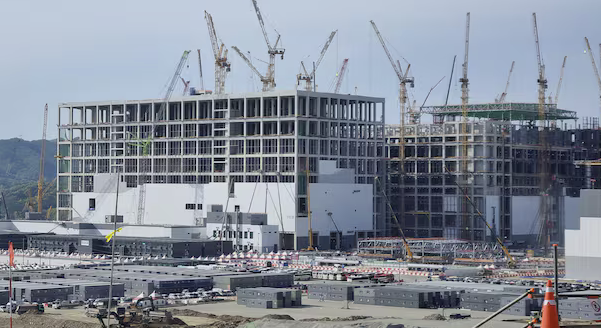
Construction is divided into two main zones. In the area designated for the first fab, the CUB, and water treatment facilities, structural framework work was in full progress. Meanwhile, in the sections allocated for fabs two through four, large-scale earthworks continued, with hills being leveled and land compacted.
At this stage, most pathways could hardly be called proper roads. The terrain was largely unpaved, requiring vehicles to navigate uneven slopes and rough ground—conditions that made four-wheel drive almost essential. The massive dump trucks on site had tires as tall as a person, and Caterpillar off-road vehicles, with nearly double the payload capacity of standard trucks, handled steep inclines with ease.
Each day, more than 17,000 workers move in and out of the site. Around 200 water trucks operate continuously to suppress dust, giving the entire area the feel of a sprawling “construction city.”
At the northern edge of the complex, the first fab is rising, with completion targeted for February next year. While the exact progress hasn’t been disclosed, the adjacent CUB has already taken shape. The fab itself will stand about 150 meters tall—roughly equivalent to a 50-story residential tower. Because semiconductor production is highly sensitive to even the slightest vibration, the foundation must extend 45 meters underground, supported by tens of thousands of driven piles.
The building’s design is equally groundbreaking. The first fab will feature six clean rooms arranged in a “triple mezzanine” configuration—placing two clean rooms on a single level to maximize efficiency. This approach, enabled by an increased floor area ratio, is considered a world-first in semiconductor construction.
Regulatory changes played a key role in enabling this scale. When Yongin City raised the allowable floor area ratio from 350% to 490%, SK hynix was able to upgrade its design from a double to a triple mezzanine structure. As a result, the projected investment surged from an initial 122 trillion won to as much as 600 trillion won. Former Yongin Mayor Lee Sang-il is said to have visited the site regularly to support the project’s progress.
Administrative backing also accelerated development. The city introduced a “partial completion” system, allowing sections of the complex to be approved in stages. This enabled companies to secure ownership registration and financing earlier, easing concerns over delays. Support from SK Group has been equally visible. At the site’s PR center, a handwritten message from Chairman Chey Tae-won—left during his visit in September 2023—expresses hopes for the project’s success as a symbol of innovation and bold ambition.
Yongin is also actively attracting semiconductor materials, parts, and equipment companies, positioning both the Samsung Electronics industrial complex (in Idong and Namsa-eup) and the SK hynix complex as twin pillars. So far, 93 domestic and international firms—including Korean branches of global leaders such as ASML, Lam Research, and Tokyo Electron—have either moved in or are planning to do so.
Infrastructure development is advancing in parallel. A substation connected to the Shin Anseong facility via a 6-kilometer underground power tunnel is nearing completion. Industrial water will be supplied from the Namhan River, 37 kilometers away, while residential water will come from the Yurim reservoir, 15 kilometers distant.
Transportation access is also improving rapidly. The site is just a 10-minute drive from Namyongin IC and about 30 minutes from Gangdong IC in Seoul. Via Yongin Junction and the Yeongdong Expressway, it is also roughly 40 minutes from SK hynix’s existing plant in Icheon—further strengthening the region’s emergence as a semiconductor powerhouse.

Project News