Ireland’s Semiconductor Sector: From Foreign Investment to Homegrown Innovation
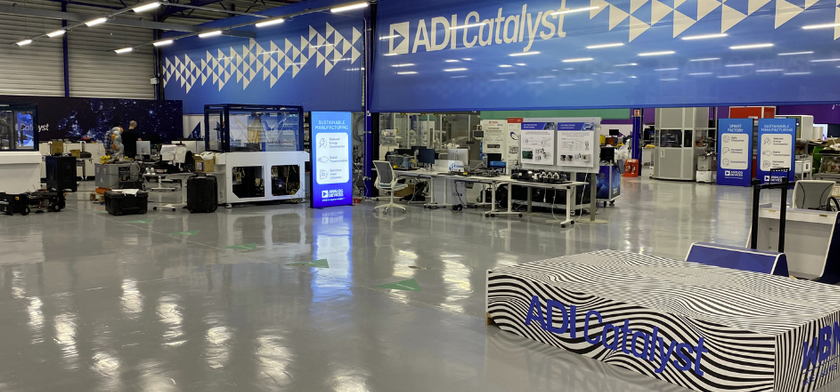
Analog Devices’ Catalyst collaboration hub in Limerick.
Despite its relatively small size, Ireland has established itself as a major player in the global semiconductor industry. Decades of foreign investment have helped build a strong foundation of expertise, talent, and innovation, enabling the country to compete well beyond its scale.
During a recent visit to Ireland, Science|Business explored how multinational technology companies continue to shape the country's semiconductor landscape. At the same time, policymakers, researchers, and industry leaders are increasingly focused on transforming this multinational presence into a sustainable ecosystem that supports Irish-founded technology companies and strengthens Europe's technological sovereignty.
A central pillar of this ecosystem is the Tyndall National Institute in Cork, one of Ireland's leading research and technology organizations. The Irish government recently committed more than €100 million to expand the institute, effectively doubling its footprint.
Tyndall has long collaborated with industry partners to bring research breakthroughs to market. According to strategic partnership manager Mehrnaz Heidari, the demands of multinational companies have played a significant role in shaping both the institute's research direction and working methods.
Ireland hosts operations from 15 of the world's 30 largest semiconductor companies. Among them is Intel, which announced a €5 billion investment in July to expand its Leixlip campus, home to Europe's most advanced chip manufacturing facility. Earlier in the year, Qualcomm unveiled a €125 million investment in AI-focused research and development in Cork, while German chipmaker Infineon opened a new R&D center in the city.
These investments have cemented semiconductors as a vital component of the Irish economy. In 2024, the government launched its Silicon Island Strategy, aimed at strengthening Ireland's position in semiconductor manufacturing, research, and innovation. A key objective is to boost both multinational activity and the domestic technology sector, recognizing that many Irish start-ups and SMEs currently view acquisition by larger foreign companies as their primary growth pathway.
The strategy emphasizes that helping indigenous semiconductor companies scale successfully is essential for innovation, economic growth, and long-term technological leadership.
Tyndall shares this vision. Heidari believes that a growing number of Irish companies launching, scaling, and remaining headquartered in Ireland would signal a healthier and more self-sustaining industry. Such growth could also help attract additional government support and investment.
The institute coordinates I-C3, one of 30 EU-funded Chips Competence Centres established under the European Chips Act. The initiative supports start-ups and SMEs by providing access to expertise, infrastructure, and investment opportunities. Tyndall also hosts three of the five pilot lines created under the Chips Act, highlighting Ireland's strategic importance in Europe's efforts to develop domestic semiconductor capabilities.
Importantly, Heidari does not see multinational companies and local businesses as competing interests. She argues that foreign investment has expanded employment opportunities, improved facilities, and increased the size of the semiconductor market in Ireland.
Irish start-ups have also benefited from the expertise within large technology companies. Through programs that connect founders with experienced mentors, Tyndall encourages knowledge transfer between established firms and emerging ventures.
A Revolving Door of Talent
Bill Henry is one example of how experience gained in multinational companies can feed back into the local innovation ecosystem.
Henry joined Tyndall in 2007 with the goal of creating a spin-out company. In 2011, he co-founded InfiniLED, which was acquired by Oculus, then owned by Facebook, in 2016. The team remained based in Cork after the acquisition.
After spending nearly a decade at Facebook and later Meta, Henry returned to Tyndall in 2024 to develop a new venture focused on advanced packaging technologies.
Reflecting on his time at Meta, Henry says the experience provided valuable insight into the challenges of turning promising technologies into scalable, sustainable businesses. He also highlights the positive role large companies can play in supporting innovation. While at Meta, he helped establish the Meta Industrial Chair in Semiconductor Technologies at Tyndall, which funded doctoral research and contributed to cutting-edge technological developments.
At the same time, Henry believes start-ups will be increasingly important as Europe seeks greater influence over future technologies. Large corporations often focus on incremental improvements and protecting established markets, he argues, while start-ups are more likely to create entirely new markets and drive disruptive innovation.
He points to the rapid development of artificial intelligence as evidence that many of today's most significant breakthroughs are emerging from smaller companies.
Henry also sees evidence that Ireland is working to better balance support between multinational firms and indigenous businesses. Although earlier policies often focused heavily on attracting foreign investment and creating jobs, he believes there is now a strong commitment to nurturing local technology companies.
While he remains open to future acquisitions, Henry says his preference is to build a company capable of addressing long-term technological needs. He believes expanding infrastructure, including pilot lines at Tyndall and across Europe, creates significant opportunities for Irish businesses to grow independently.
Fifty Years of Foreign Investment
Ireland's reputation as a technology hub extends beyond today's AI giants such as Meta, Google, and OpenAI. Semiconductor companies from the United States have been investing in the country for more than half a century.
One of the earliest pioneers was Analog Devices, which celebrated 50 years in Ireland in 2024. According to Anne-Marie Tierney of IDA Ireland, the company's arrival in the 1970s was a landmark moment in the nation's economic development.
Analog Devices established operations in Limerick on the condition that what later became the University of Limerick would adapt its educational programs to provide the skills required by the company. This close collaboration between industry and academia helped lay the foundations of Ireland's semiconductor sector.
Over five decades, Analog Devices has expanded from just 13 employees in Ireland to approximately 2,100, with more than half working in research and development. Limerick now hosts the company's European Research and Development Centre as well as Catalyst, a €100 million innovation hub launched in 2022 to accelerate new technology development through collaboration among customers, suppliers, and partners.
According to Paul Dillon, director of the University of Limerick's technology transfer office, the industry's knowledge base began within companies such as Analog Devices, with universities evolving to supply the talent and expertise that industry demanded.
Strengthening Industry and Research Collaboration
The Irish government has actively encouraged collaboration between academia and industry. Alongside research funding opportunities, a national intellectual property protocol introduced in 2012 simplified the process of establishing joint research projects.
These measures were part of broader efforts to maximize the impact of public research investment following the 2008 financial crisis.
In 2014, Ireland established Knowledge Transfer Ireland, a national organization responsible for coordinating and supporting technology transfer activities across universities. Additional incentives target private-sector innovation directly. Most recently, Ireland increased its R&D tax credit from 30% to 35% of eligible research costs, and companies can claim the credit even if they are not yet profitable.
Together, these initiatives reflect Ireland's strategy of building on decades of successful foreign investment while creating the conditions for a stronger and more sustainable homegrown semiconductor industry.

Project News