Silicon Island: Penang’s Bold Bet on Next Gen. Semiconductors
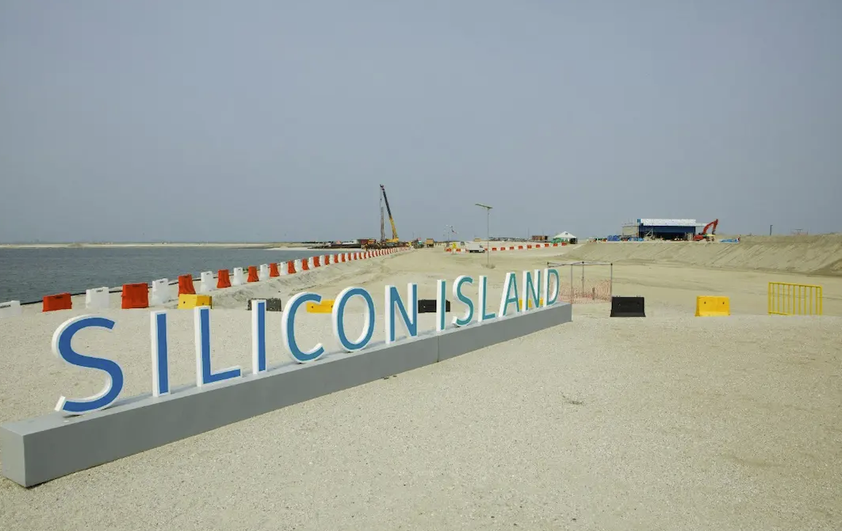
Malaysia builds a new ‘Silicon Island’ to house its AI ambitions
Just off the southern coast of Penang, Malaysia is creating new land from the sea in an ambitious effort to secure its position in the global semiconductor industry.
Excavators are reshaping a stretch of blue-green water as trucks move across newly reclaimed sand and large orange pipes carry material pumped ashore by offshore dredgers. The emerging development, known as Silicon Island, is intended to become a major new centre for advanced technology and manufacturing.
When completed sometime next decade, the 2,300-acre development is expected to strengthen Malaysia’s role in the semiconductor supply chain while creating approximately 220,000 jobs by 2050. Almost three times the size of New York’s Central Park, the planned island will combine high-tech industry with offices, hotels and waterfront residential developments.
The scale of the project reflects a challenge created partly by Penang’s own economic success.
For more than five decades, the state has developed one of Southeast Asia’s most important electronics and semiconductor clusters. Major technology companies including Intel Corp, Advanced Micro Devices Inc and ASE Technology Holding Co have expanded their operations around Bayan Lepas, the extensive manufacturing district close to Penang International Airport.
But Penang is one of Malaysia’s smallest states, and space for further industrial development is becoming increasingly scarce.
Silicon Island is designed to provide room for the next stage of that growth. Just as importantly, it supports Malaysia’s ambition to move beyond its established expertise in semiconductor assembly and testing and into higher-value areas including chip design and advanced packaging.
Artificial intelligence could provide another powerful catalyst. The rapid expansion of AI infrastructure is increasing global demand for semiconductors and encouraging companies to diversify manufacturing capacity across multiple countries.
Penang Chief Minister Chow Kon Yeow said space for continued expansion in the state was becoming “increasingly constrained”.
“Silicon Island represents an important opportunity to build on Penang’s existing industrial strengths while positioning the state for the next phase of the global technology cycle,” he told Bloomberg News.
A Potential RM1.1 Trillion Economic Contribution
The economic ambitions surrounding the development are substantial.
According to a Deloitte study cited by Silicon Island Development Sdn Bhd, the project could contribute a cumulative RM1.1 trillion to Malaysia’s economic output through 2050 while attracting approximately RM75 billion in investment.
Silicon Island Development is controlled by Malaysian infrastructure group Gamuda Bhd and backed by the Penang state government.
Penang already accounts for around 5% of global semiconductor exports, according to the state government. Its electronics industry can trace its origins to the early 1970s, when the historic trading centre began attracting international manufacturers as part of an effort to create employment and diversify an economy previously associated with commodities such as spices, tin and rubber.
That strategy has helped Malaysia become the world’s sixth-largest semiconductor exporter.
Demand is continuing to grow. Malaysia Semiconductor Industry Association president Wong Siew Hai recently increased his forecast for Malaysia’s electrical and electronics exports this year by around 13%, to more than RM900 billion. Semiconductors represent almost three-quarters of those shipments.
The construction of AI infrastructure is now generating growth throughout the supply chain. Some manufacturers are already operating at capacity and looking for locations where they can expand, according to Wong, who previously spent 27 years at Intel.
Supply Chains Are Looking Beyond China
Geopolitical change is also working in Penang’s favour.
US-China tensions have encouraged manufacturers to diversify production and reduce their reliance on China. Penang offers companies an established manufacturing ecosystem supported by existing factories, engineering talent and suppliers.
Interest in Silicon Island is already emerging from both Malaysian and overseas businesses, with particularly encouraging signs from Taiwan and Japan, according to Chief Minister Chow.
Tan Jun Jing, deputy project director at Silicon Island Development and a Gamuda executive, described one potential Japanese investor that visited the site three times in only two months. Each visit involved increasingly senior leadership, beginning with the company’s Malaysian chief executive, followed by its Japan-based chief executive officer and eventually its chairman.
According to Tan, discussions with potential investors have highlighted the strength of current semiconductor demand.
Suppliers serving customers including Intel and Nvidia are increasingly focused on how rapidly they can expand capacity, with speed of production becoming a bigger consideration than cost.
“The current commitment these companies are asking for is ‘how much and how fast can you produce?’” Tan said. “That’s why a lot of them are really exploring expansion to meet customer demand.”
Building a New Technology Hub Will Take Time
The transformation will not happen overnight.
Reclaiming the entire island could require another three to four years, while full development may take as long as 15 years, according to Tan. The first industrial operations are expected to begin by early 2029.
Penang will also face growing competition for investment.
Singapore is expanding its advanced manufacturing capabilities, Vietnam is competing for a greater share of international projects, and India is investing heavily in its own semiconductor ambitions. Within Malaysia itself, states including Kedah and Selangor are also attempting to attract chip manufacturers.
The cost of developing reclaimed land presents another challenge.
Higher property prices could make Silicon Island less attractive to lower-margin manufacturers. Wong believes that makes higher-value technology companies the most likely tenants. For companies investing billions in a new semiconductor facility, however, land accounts for a relatively small proportion of total expenditure.
Tan believes Silicon Island could ultimately play a role similar to that of the Bayan Lepas Free Industrial Zone, which has supported Penang’s technology industry for the past half-century.
Intel, one of the pioneering overseas companies behind Penang’s emergence as a technology centre, is also involved in the state’s effort to expand beyond traditional semiconductor assembly and testing. Chief executive officer Lip-Bu Tan met Chow in December for an update on Intel’s RM12 billion advanced-packaging facility in the state.
Green Tech at the Heart of the Development
At the centre of Silicon Island will be a Green Tech Park covering approximately 700 acres.
The development is targeting businesses involved in areas including semiconductor design, advanced packaging and automated testing. According to Silicon Island Development, its first phase is planned to operate entirely on renewable energy.
A 380-metre bridge is eventually expected to connect the new development with Penang’s main island.
Its location near Penang International Airport is an important part of the strategy. Tan said companies considering Silicon Island are likely to depend primarily on air freight for incoming materials and outgoing products.
Heavy manufacturers that rely more extensively on maritime freight may be better suited to mainland locations with easier access to port facilities.
Financing Penang’s Next 50 Years
Gamuda holds a 70% stake in Silicon Island Development and is financing RM14 billion in reclamation and infrastructure costs through a syndicated loan, according to Tan.
The project expects to reach break-even within eight years, with the first sale of industrial land scheduled for early 2027.
The Penang government holds the remaining stake and is entitled to 30% of the venture’s profits. Chow said the state will also ultimately own the reclaimed land and determine how it is allocated and developed.
Silicon Island therefore represents far more than a land-reclamation project.
For Penang, it is a long-term wager that the forces transforming the global technology industry, from artificial intelligence and semiconductor demand to the diversification of international supply chains, will create a new generation of investment.
Half a century ago, Bayan Lepas helped transform Penang from a historic trading centre into a global electronics hub. Silicon Island is designed to provide the space, infrastructure and ambition for the state to attempt that transformation all over again.

Project News